
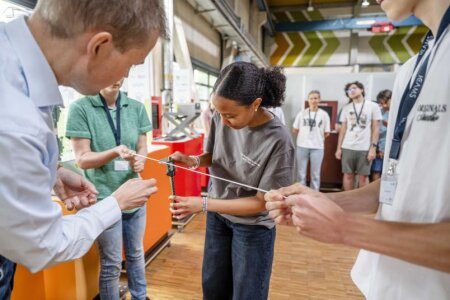
A shoelace can withstand much more than one might think. The participants of the Summer School Materialforschung have put this to the test.
Students from grades ten to twelve are fixated on a white shoelace. It is clamped in a device that pulls it apart millimeter by millimeter. Those who look closely can see that it is becoming thinner and longer. How much tension can it withstand? The initial cautious estimate was five kilograms, and someone offered to go up to 30 kilograms. Yet the shoelace still holds.
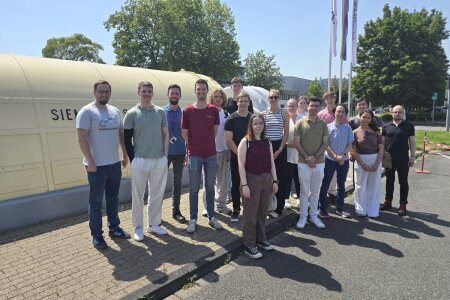
As part of our lecture “Materials Science: History, Material Cycles, and Analysis of Important Reactions in and on Materials (MW-GSA),” our students, student assistants, and research associates had the opportunity to experience material production and processing on an industrial scale firsthand at local companies. Alexander Luithle and Jannis Timms gave detailed insights into the tasks and work of materials engineers at Siemens Energy in Mülheim an der Ruhr. At Trimet in Essen, we were welcomed by Felicitas Werner and Alice Siegmund. They showed us the molten salt electrolysis, the foundry, as well as the storage and shipping areas. We thank all people involved for the impressions made and the kind hospitality. Furthermore, thanks are due to Tim Storch, Clara Pohl and Marcel Münch for the organization of the excursions.
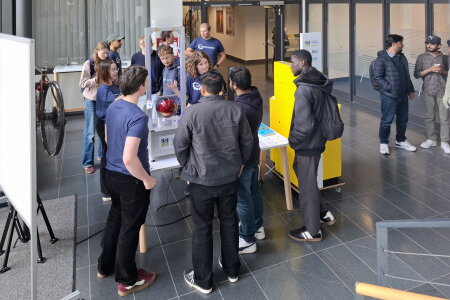
On June 11, 2026, as part of InsideRUB, we informed prospective and current students about the opportunities and conditions of studying Mechanical Engineering or Materials Science and Engineering. We would like to thank the staff of the Chairs for Materials Science and Engineering and Materials Technology for their commitment.
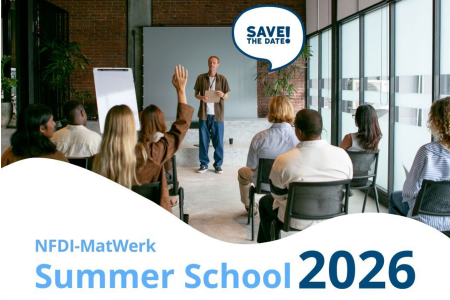
From Monday, September 21 to Wednesday, September 23, 2026, ICAMS, our chair and NFDI-Matwerk will organize the NFDI-MatWerk Summer School 2026. Students, doctoral students and postdocs working in experimental and/or modeling/simulation in any field of materials science and engineering (with or without experience in research data management) are welcome to get an introduction into the possibilities and challenges of research data management. Participation is free of charge. Registration via the website (see the More Info button) is required. There is a limited number of places.
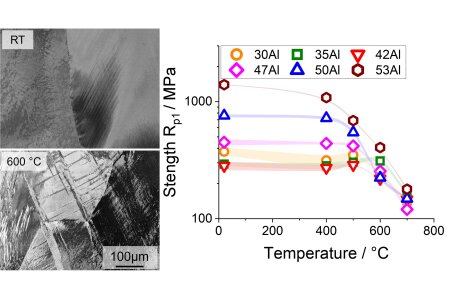
In a collaborative work of Karlsruhe Institute of Technology, Max Planck Institute for Sustainable Materials and Ruhr University Bochum, we present a comprehensive dataset on temperature-dependent strength, work hardening, and microstructure evolution during plastic deformation of B2-ordered iron aluminides. The study covers the entire stability range of the B2 phase and employs well-defined heat treatment conditions to successfully isolate the contribution of mechanical strength to composition-dependent embrittlement in these alloys.
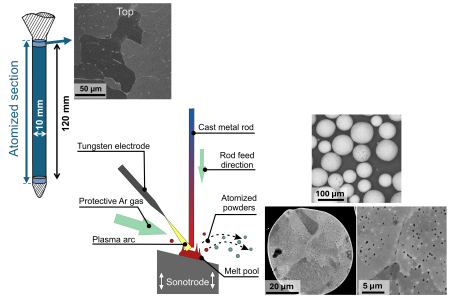
In our collaborative work of Karlsruhe Institute of Technology (KIT) and Ruhr University Bochum, we developed an innovative method that leverages residual oxygen from elemental yttrium feedstock and process atmosphere to form Y-Ti-O dispersoids in-situ during liquid atomization, eliminating the need for Y2O3 powder. Our study reveals that these dispersoids exhibit remarkable compositional stability during heat treatment and field-assisted sintering, achieving a microhardness of (282 ± 18) HV0.05 in high-dispersoid-density regions. This promising alternative to mechanical alloying offers a new avenue for fabricating high-performance ODS alloys.
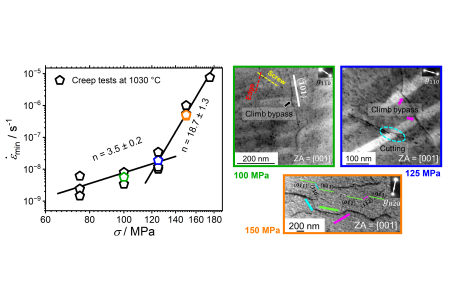
The refractory alloy 27.3Ta-27.3Mo-27.3Ti-8Cr-10Al (at.%) was designed to replicate Ni-base superalloys’ microstructures. While phase transformations and creep behavior were previously studied, detailed creep mechanisms remained unclear. Our collaborative work with IISc Bangalore, Karlsruhe Institute of Technology, and Ruhr University Bochum reveals 3D precipitate morphology changes during rafting, interface coherency evolution, dislocation activity, and dislocation-precipitate interactions.
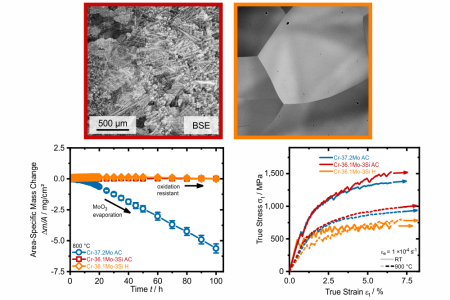
Despite the progress in renewable energy, enhancing the efficiency of energy conversion from traditional or synthetic fuels remains a critical challenge. This is particularly true for long-range aircraft, which will continue to rely on combustion engines for a long time. One promising approach to boost efficiency is to increase the operating temperatures of these engines. In our latest publication, we present a novel refractory-element-based alloy that combines oxidation resistance and plastic deformability at room temperature, two critical aspects that were previously not resolved in refractory elements.
Copyright © LWW 2026
Last update: 2026/08/03 | 10 am
