20.05.2026
The refractory alloy 27.3Ta-27.3Mo-27.3Ti-8Cr-10Al (at.%) was designed to replicate Ni-base superalloys’ microstructures. While phase transformations and creep behavior were previously studied, detailed creep mechanisms remained unclear. Our collaborative work with IISc Bangalore, Karlsruhe Institute of Technology, and Ruhr University Bochum reveals 3D precipitate morphology changes during rafting, interface coherency evolution, dislocation activity, and dislocation-precipitate interactions.
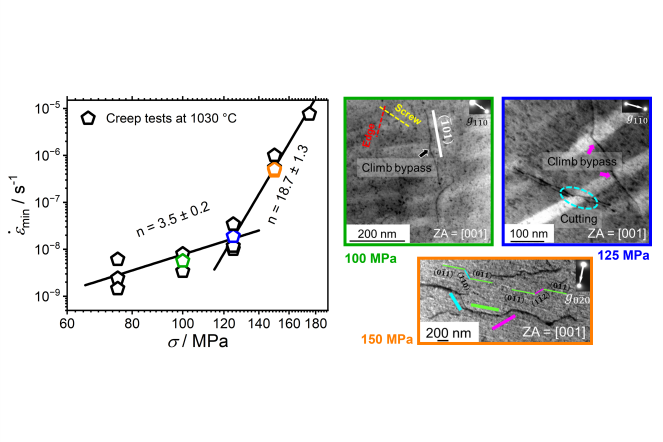
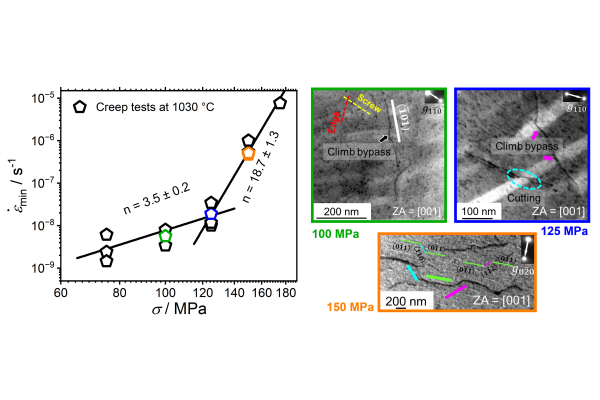
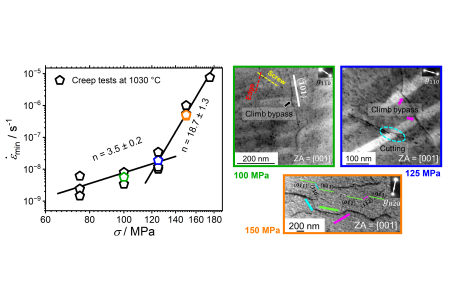
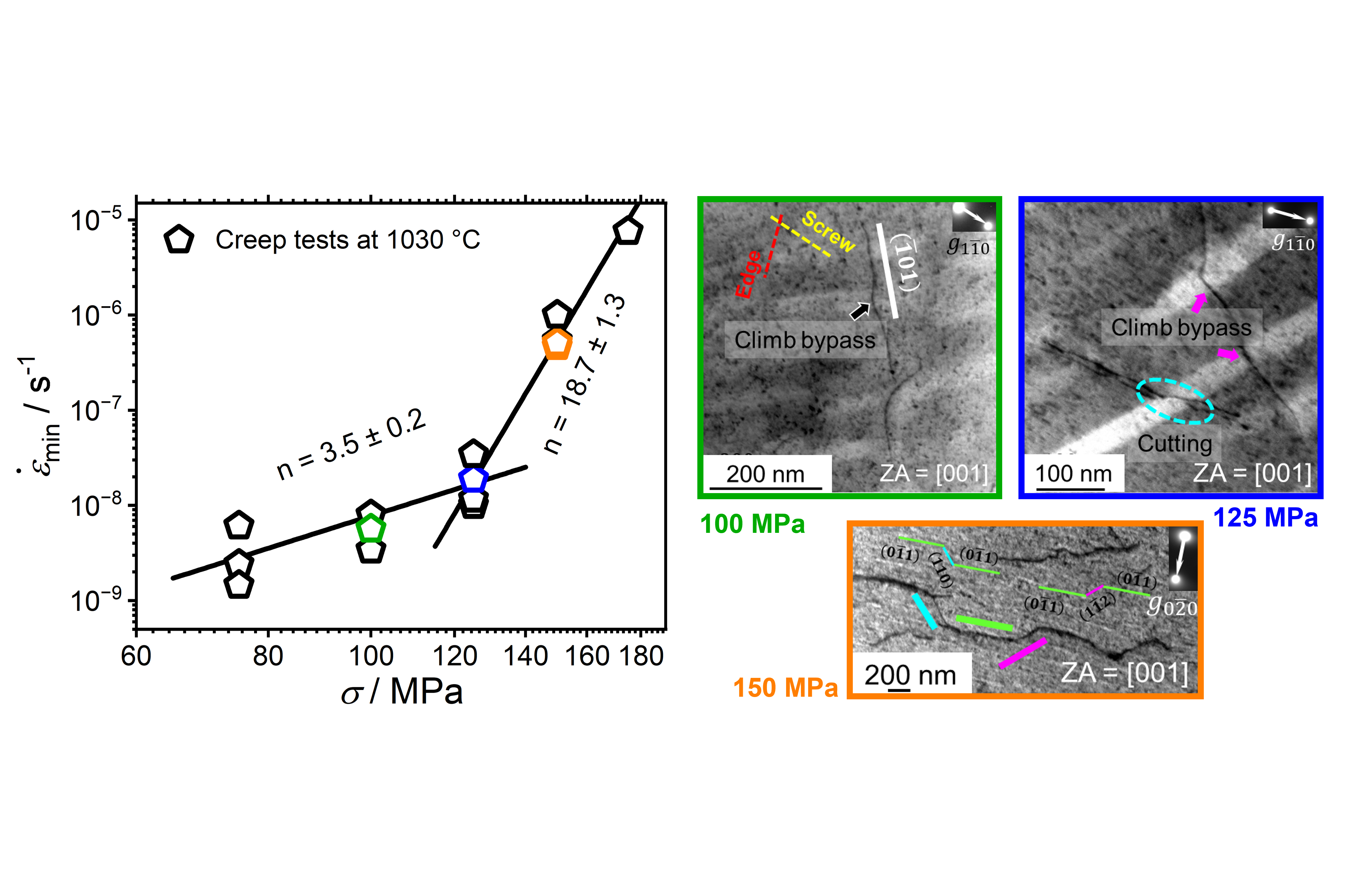
The refractory high-entropy alloy with a precipitation-strengthened A2-B2 microstructure exhibits substantial B2 raft formation and a transition in apparent creep exponent near 125 MPa at 1030 °C. Using focused ion beam-based 3D sectioning, the B2 precipitates were identified as having a plate-like geometry, characterized by elongation along two orthogonal faces and faceting on the third face, a morphology that cannot be resolved by conventional 2D imaging. Electron backscattered diffraction analysis reveals the formation of low-misorientation subgrain structures, consistent with dynamic recovery processes. Transmission electron microscopy (TEM) analyses reveal a change in dislocation–precipitate interaction with increasing applied stress. At low stresses, dislocation climb is confirmed, whereas at high stresses, deformation is likely associated with cross slip of screw dislocations. In the intermediate stress region, deformation is characterized by a combination of climb-controlled dislocation-precipitate interaction, jogged-screw dislocations, and the cutting of B2 precipitates by strongly coupled dislocation pairs. High-resolution scanning TEM further confirms that the A2/B2 interface remains fully coherent across all creep conditions examined, maintaining structural stability under high-temperature deformation.
The refractory alloy 27.3Ta-27.3Mo-27.3Ti-8Cr-10Al (at.%) was designed to replicate Ni-base superalloys’ microstructures. While phase transformations and creep behavior were previously studied, detailed creep mechanisms remained unclear. Our collaborative work with IISc Bangalore, Karlsruhe Institute of Technology, and Ruhr University Bochum reveals 3D precipitate morphology changes during rafting, interface coherency evolution, dislocation activity, and dislocation-precipitate interactions.
The refractory high-entropy alloy with a precipitation-strengthened A2-B2 microstructure exhibits substantial B2 raft formation and a transition in apparent creep exponent near 125 MPa at 1030 °C. Using focused ion beam-based 3D sectioning, the B2 precipitates were identified as having a plate-like geometry, characterized by elongation along two orthogonal faces and faceting on the third face, a morphology that cannot be resolved by conventional 2D imaging. Electron backscattered diffraction analysis reveals the formation of low-misorientation subgrain structures, consistent with dynamic recovery processes. Transmission electron microscopy (TEM) analyses reveal a change in dislocation–precipitate interaction with increasing applied stress. At low stresses, dislocation climb is confirmed, whereas at high stresses, deformation is likely associated with cross slip of screw dislocations. In the intermediate stress region, deformation is characterized by a combination of climb-controlled dislocation-precipitate interaction, jogged-screw dislocations, and the cutting of B2 precipitates by strongly coupled dislocation pairs. High-resolution scanning TEM further confirms that the A2/B2 interface remains fully coherent across all creep conditions examined, maintaining structural stability under high-temperature deformation.
Copyright © LWW 2026
Last update: Jul 28, 2026