09.04.2026
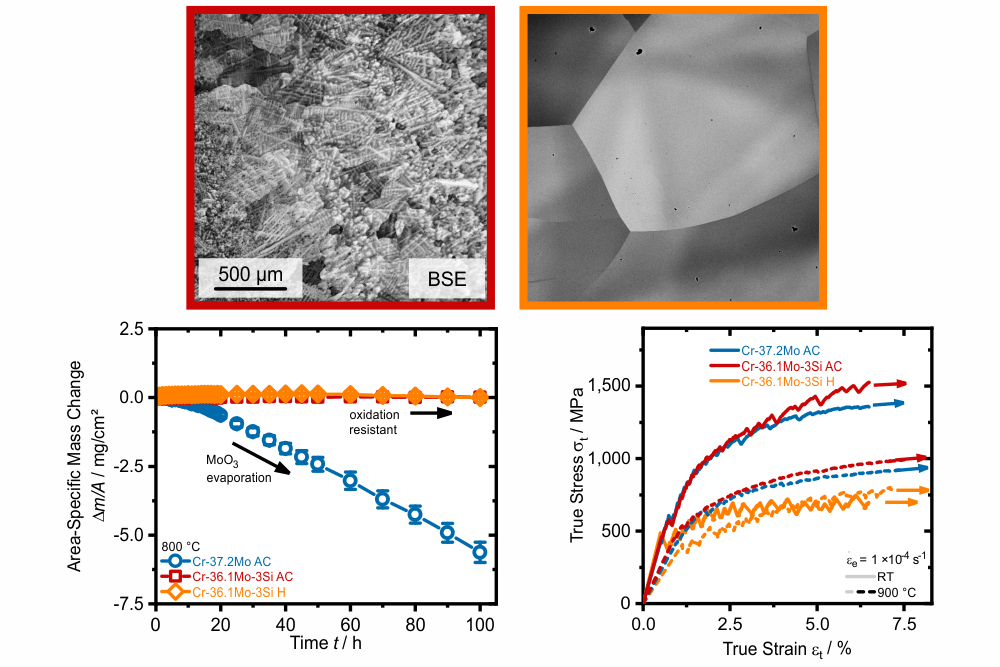
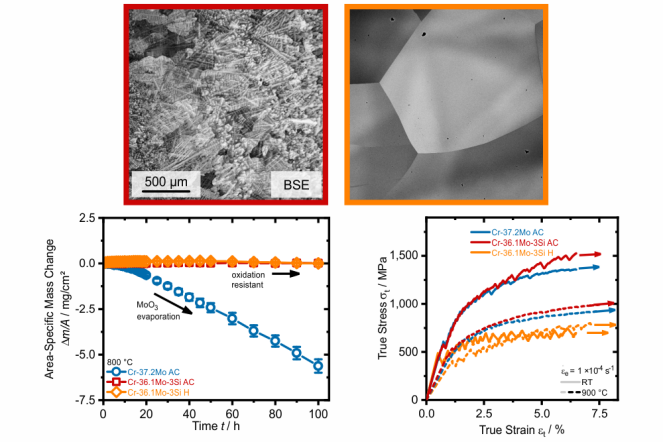
Despite the progress in renewable energy, enhancing the efficiency of energy conversion from traditional or synthetic fuels remains a critical challenge. This is particularly true for long-range aircraft, which will continue to rely on combustion engines for a long time. One promising approach to boost efficiency is to increase the operating temperatures of these engines. In our latest publication, we present a novel refractory-element-based alloy that combines oxidation resistance and plastic deformability at room temperature, two critical aspects that were previously not resolved in refractory elements.
Refractory-element-based materials, with their significantly higher solidus temperatures exceeding 2,000 °C, are prime candidates for this purpose. In a significant advancement, we introduce a single-phase Cr-36.1Mo-3Si (at.%) alloy that meets two crucial requirements for refractory-element-based materials: (1) robust resistance against pesting, nitridation, and scale spallation at elevated temperatures, up to at least 1,100 °C, and (2) adequate compression ductility at room temperature.
While the strength and creep resistance of such alloys have previously surpassed those of Ni-based superalloys in several instances, challenges related to oxidation/corrosion resistance and ductility/toughness have persisted. These properties are vital for withstanding the harsh combustion atmosphere and ensuring damage tolerance and device setting, respectively. Previous attempts to mitigate the severe oxidation of Mo and nitridation of Cr during oxidation have often resulted in a loss of ductility at ambient temperatures.
Despite the progress in renewable energy, enhancing the efficiency of energy conversion from traditional or synthetic fuels remains a critical challenge. This is particularly true for long-range aircraft, which will continue to rely on combustion engines for a long time. One promising approach to boost efficiency is to increase the operating temperatures of these engines. In our latest publication, we present a novel refractory-element-based alloy that combines oxidation resistance and plastic deformability at room temperature, two critical aspects that were previously not resolved in refractory elements.
Refractory-element-based materials, with their significantly higher solidus temperatures exceeding 2,000 °C, are prime candidates for this purpose. In a significant advancement, we introduce a single-phase Cr-36.1Mo-3Si (at.%) alloy that meets two crucial requirements for refractory-element-based materials: (1) robust resistance against pesting, nitridation, and scale spallation at elevated temperatures, up to at least 1,100 °C, and (2) adequate compression ductility at room temperature.
While the strength and creep resistance of such alloys have previously surpassed those of Ni-based superalloys in several instances, challenges related to oxidation/corrosion resistance and ductility/toughness have persisted. These properties are vital for withstanding the harsh combustion atmosphere and ensuring damage tolerance and device setting, respectively. Previous attempts to mitigate the severe oxidation of Mo and nitridation of Cr during oxidation have often resulted in a loss of ductility at ambient temperatures.
Copyright © LWW 2026
Last update: Jul 28, 2026