23.05.2026
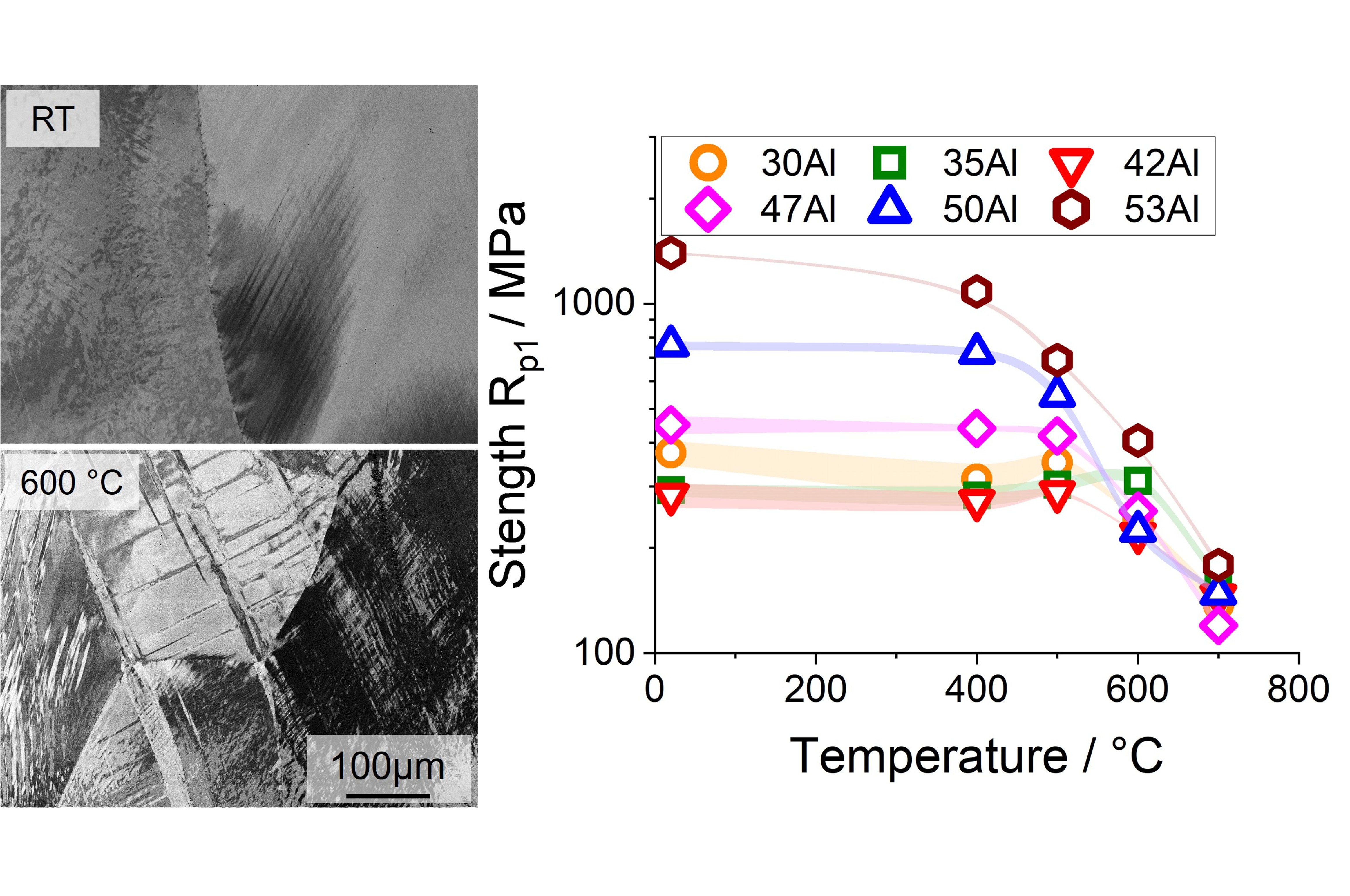
In a collaborative work of Karlsruhe Institute of Technology, Max Planck Institute for Sustainable Materials and Ruhr University Bochum, we present a comprehensive dataset on temperature-dependent strength, work hardening, and microstructure evolution during plastic deformation of B2-ordered iron aluminides. The study covers the entire stability range of the B2 phase and employs well-defined heat treatment conditions to successfully isolate the contribution of mechanical strength to composition-dependent embrittlement in these alloys.
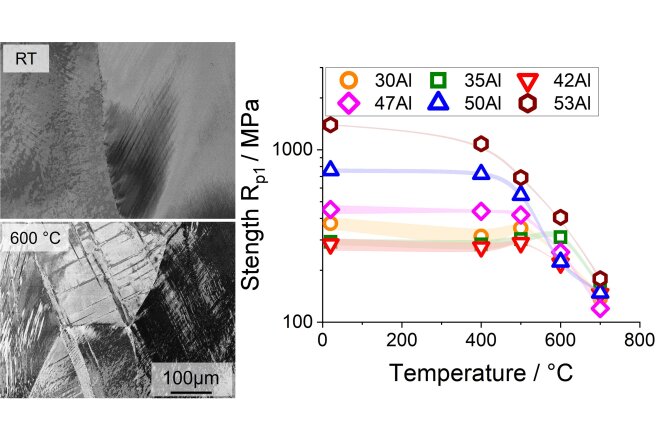
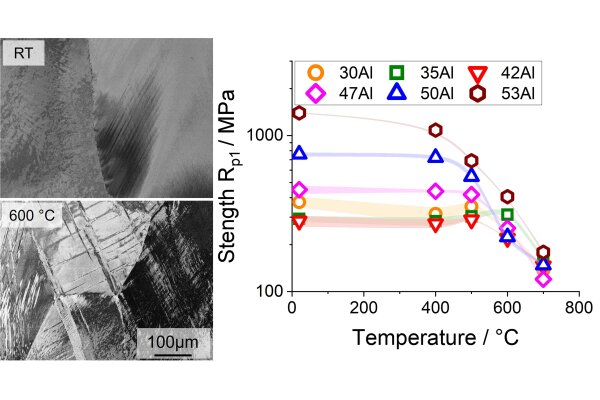
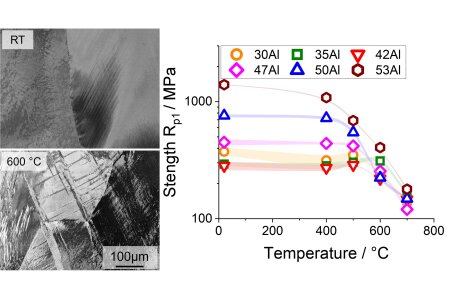
Iron aluminides are promising structural materials for temperatures up to 700 °C. Among them, single-phase, B2-ordered iron aluminides containing 35 - 50 at.% Al are of particular interest due to their exceptional oxidation and sulfidation resistance. However, their use is limited by low ductility, primarily caused by environmental embrittlement, especially in alloys with >40 at.% Al, and vacancy strengthening. Despite extensive research, the understanding of the combined effects of point defects, environmental embrittlement, and deformation mechanisms across the entire Al range has been lacking. The present study addresses this gap by systematically characterizing the composition- and temperature-dependent mechanical behavior of a series of alloys with 30 to 53 at.% Al from room temperature (RT) up to 700 °C. Particular emphasis was placed on achieving uniformly low impurity levels and establishing similar heat treatment conditions to reduce the strengthening effect of vacancies. Compression tests are employed to investigate the plastic deformation behavior and avoid premature failure. At RT, a minimum of hardness and offset yield strength is observed at 42 at.% Al, corresponding to the lowest vacancy and anti-site strengthening contribution. In the temperature range between 400 and 600 °C, a yield strength peak was observed for the alloys with 30 and 35 at.% Al related to the formation of D03-ordered domains (Fe-30Al) and the strengthening effect by thermal vacancies (Fe-35Al). The continuously decreasing strain hardening capability with increasing temperature and Al content is rationalized by thermally activated processes, increasing vacancy concentration and localized plastic deformation.
In a collaborative work of Karlsruhe Institute of Technology, Max Planck Institute for Sustainable Materials and Ruhr University Bochum, we present a comprehensive dataset on temperature-dependent strength, work hardening, and microstructure evolution during plastic deformation of B2-ordered iron aluminides. The study covers the entire stability range of the B2 phase and employs well-defined heat treatment conditions to successfully isolate the contribution of mechanical strength to composition-dependent embrittlement in these alloys.
Iron aluminides are promising structural materials for temperatures up to 700 °C. Among them, single-phase, B2-ordered iron aluminides containing 35 - 50 at.% Al are of particular interest due to their exceptional oxidation and sulfidation resistance. However, their use is limited by low ductility, primarily caused by environmental embrittlement, especially in alloys with >40 at.% Al, and vacancy strengthening. Despite extensive research, the understanding of the combined effects of point defects, environmental embrittlement, and deformation mechanisms across the entire Al range has been lacking. The present study addresses this gap by systematically characterizing the composition- and temperature-dependent mechanical behavior of a series of alloys with 30 to 53 at.% Al from room temperature (RT) up to 700 °C. Particular emphasis was placed on achieving uniformly low impurity levels and establishing similar heat treatment conditions to reduce the strengthening effect of vacancies. Compression tests are employed to investigate the plastic deformation behavior and avoid premature failure. At RT, a minimum of hardness and offset yield strength is observed at 42 at.% Al, corresponding to the lowest vacancy and anti-site strengthening contribution. In the temperature range between 400 and 600 °C, a yield strength peak was observed for the alloys with 30 and 35 at.% Al related to the formation of D03-ordered domains (Fe-30Al) and the strengthening effect by thermal vacancies (Fe-35Al). The continuously decreasing strain hardening capability with increasing temperature and Al content is rationalized by thermally activated processes, increasing vacancy concentration and localized plastic deformation.
Copyright © LWW 2026
Last update: Jul 28, 2026