06.07.2026
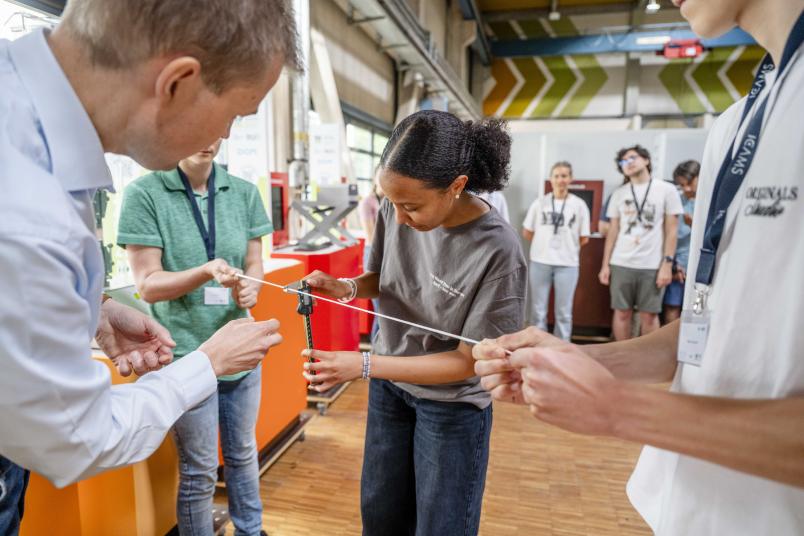
A shoelace can withstand much more than one might think. The participants of the Summer School Materialforschung have put this to the test.
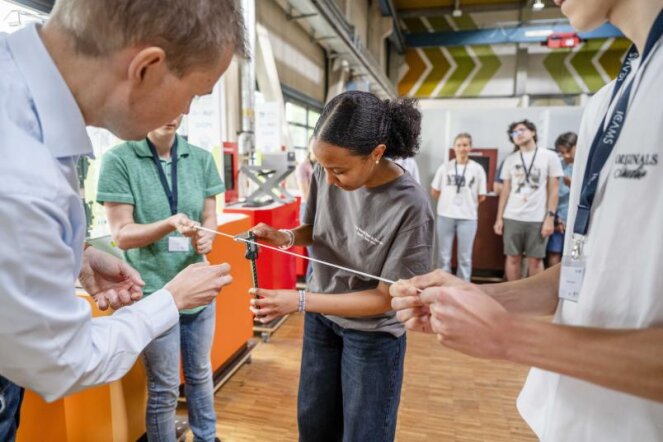
Students from grades ten to twelve are fixated on a white shoelace. It is clamped in a device that pulls it apart millimeter by millimeter. Those who look closely can see that it is becoming thinner and longer. How much tension can it withstand? The initial cautious estimate was five kilograms, and someone offered to go up to 30 kilograms. Yet the shoelace still holds.
Just as eager as the students, who have come from Bochum and surrounding cities for two days of the Summer School Materialforschung, are their organizers from the Institute for Materials at Ruhr-Universität and the Interdisciplinary Centre for Advanced Materials Simulation ICAMS. In their daily work, they deal less with textiles and more with metallic materials that, among other things, ensure that cars are safe, airplanes are light, and catalysts are powerful.
Over the two days of the Summer School, they illustrate this work to the participants, who have not come in class groups but have registered independently. “My mother saw the offer on the internet,” says Sam from Herne. “I then registered and was released from school upon presentation of a stamped confirmation.” His interest lies in mechanical engineering. “Material research is also interesting, but very specific,” is his conclusion after the first day.
The Summer School has various topics on the program, which are first investigated in small groups at ICAMS through simulation and then later tried out in experiments. Nine test stations from an exhibition have recently been available for this purpose, which can be operated independently after a brief introduction, such as the tensile test in which the shoelace can now withstand over 50 kilograms of tension. Other test stations invite microscopy, determine the heat distribution in materials, or allow them to be examined using X-ray spectrometry.
" I’m really enjoying this," says Djamy from Bochum, who comes with a friend from Hildegardis-Schule, where a chemistry teacher made her aware of the Summer School offer. “Whether I will study this or do it more on the side, I don’t know yet.”
Organizer Prof. Dr. Sebastian Weber is satisfied: “We offer the Summer School every year, and this time we have 24 participants, which is a great success.”
The tensile test was finally successful: at a load of 750 Newtons, the shoelace tore. It can therefore carry more than 75 kilograms, who would have thought?
(Meike Drießen, RUB)
We thank all the contributors of ICAMS and IW for this successful event.
A shoelace can withstand much more than one might think. The participants of the Summer School Materialforschung have put this to the test.
Students from grades ten to twelve are fixated on a white shoelace. It is clamped in a device that pulls it apart millimeter by millimeter. Those who look closely can see that it is becoming thinner and longer. How much tension can it withstand? The initial cautious estimate was five kilograms, and someone offered to go up to 30 kilograms. Yet the shoelace still holds.
Just as eager as the students, who have come from Bochum and surrounding cities for two days of the Summer School Materialforschung, are their organizers from the Institute for Materials at Ruhr-Universität and the Interdisciplinary Centre for Advanced Materials Simulation ICAMS. In their daily work, they deal less with textiles and more with metallic materials that, among other things, ensure that cars are safe, airplanes are light, and catalysts are powerful.
Over the two days of the Summer School, they illustrate this work to the participants, who have not come in class groups but have registered independently. “My mother saw the offer on the internet,” says Sam from Herne. “I then registered and was released from school upon presentation of a stamped confirmation.” His interest lies in mechanical engineering. “Material research is also interesting, but very specific,” is his conclusion after the first day.
The Summer School has various topics on the program, which are first investigated in small groups at ICAMS through simulation and then later tried out in experiments. Nine test stations from an exhibition have recently been available for this purpose, which can be operated independently after a brief introduction, such as the tensile test in which the shoelace can now withstand over 50 kilograms of tension. Other test stations invite microscopy, determine the heat distribution in materials, or allow them to be examined using X-ray spectrometry.
" I’m really enjoying this," says Djamy from Bochum, who comes with a friend from Hildegardis-Schule, where a chemistry teacher made her aware of the Summer School offer. “Whether I will study this or do it more on the side, I don’t know yet.”
Organizer Prof. Dr. Sebastian Weber is satisfied: “We offer the Summer School every year, and this time we have 24 participants, which is a great success.”
The tensile test was finally successful: at a load of 750 Newtons, the shoelace tore. It can therefore carry more than 75 kilograms, who would have thought?
(Meike Drießen, RUB)
We thank all the contributors of ICAMS and IW for this successful event.
Copyright © LWW 2026
Last update: Jul 28, 2026