21.05.2026
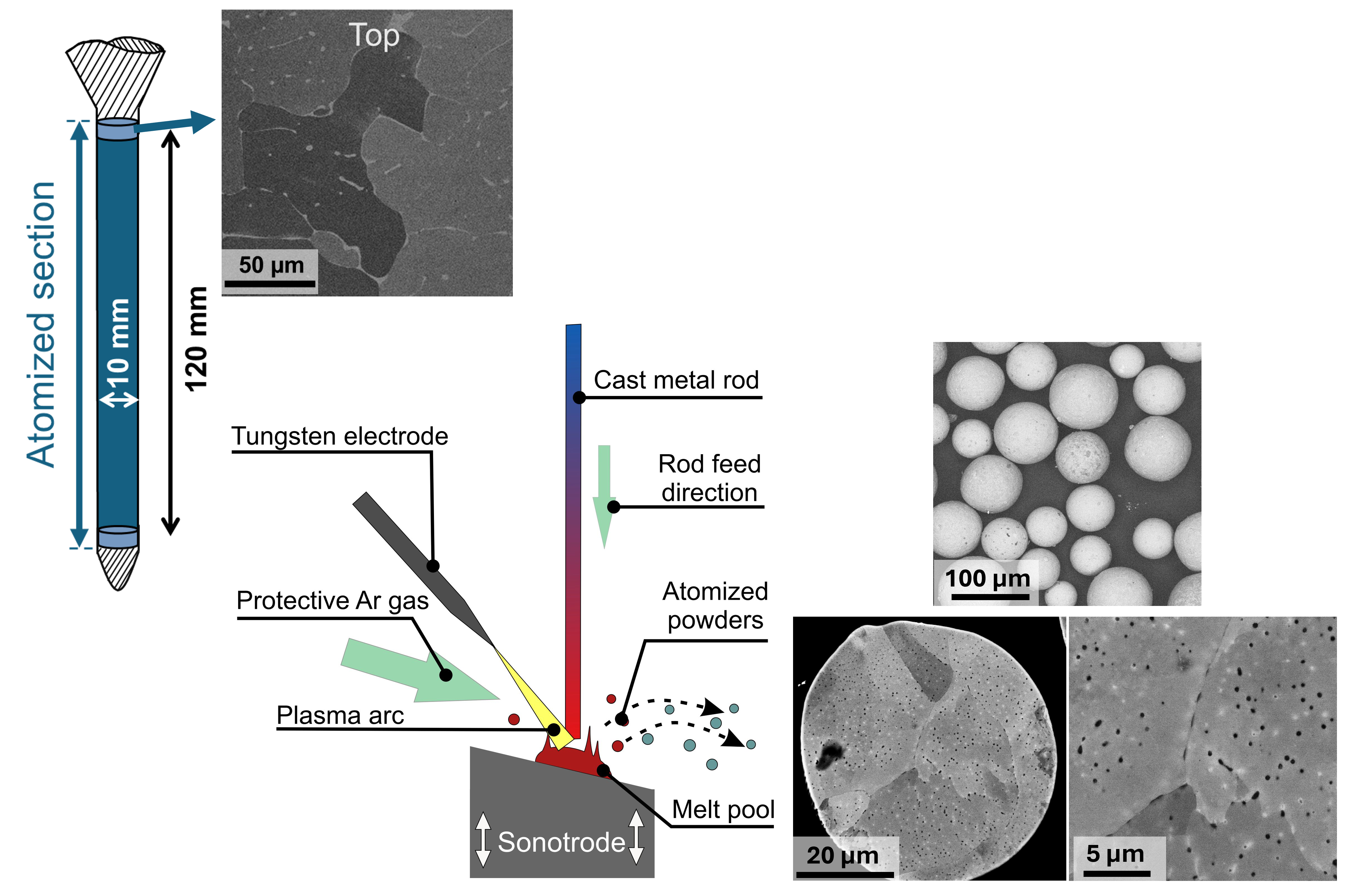
In our collaborative work of Karlsruhe Institute of Technology (KIT) and Ruhr University Bochum, we developed an innovative method that leverages residual oxygen from elemental yttrium feedstock and process atmosphere to form Y-Ti-O dispersoids in-situ during liquid atomization, eliminating the need for Y2O3 powder. Our study reveals that these dispersoids exhibit remarkable compositional stability during heat treatment and field-assisted sintering, achieving a microhardness of (282 ± 18) HV0.05 in high-dispersoid-density regions. This promising alternative to mechanical alloying offers a new avenue for fabricating high-performance ODS alloys.
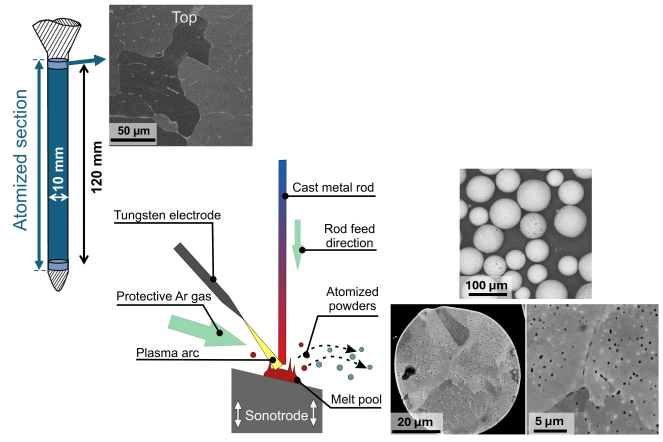
The study presents a novel powder metallurgical route for an oxide dispersion strengthened (ODS) ferritic Fe–14Cr–0.4Ti–0.5Y (wt.%) alloy using ultrasonic atomization (UA) as an alternative to conventional mechanical alloying. The key novelty lies in exploiting residual O inherent to the elemental Y feedstock and process atmosphere as an internal oxidant, driving in-situ formation of Y42Ti10O45 dispersoids directly from the liquid during atomization without utilizing Y2O3 powder. Diffusion length calculations and dispersoid spatial distributions confirm the liquid-phase nucleation and growth prior to matrix solidification. The dispersoids (20–100 nm) exhibit compositional stability during heat treatment at 1100 °C and field-assisted sintering at 1130 °C, though dispersoid density varies between powder particles due to non-uniform Y distribution in the melt pool. A microhardness of (282 ± 18) HV0.05 in high-dispersoid-density regions of consolidated samples is reached. This is comparable to mechanically alloyed counterparts, demonstrating UA as a promising alternative for ODS alloy fabrication.
In our collaborative work of Karlsruhe Institute of Technology (KIT) and Ruhr University Bochum, we developed an innovative method that leverages residual oxygen from elemental yttrium feedstock and process atmosphere to form Y-Ti-O dispersoids in-situ during liquid atomization, eliminating the need for Y2O3 powder. Our study reveals that these dispersoids exhibit remarkable compositional stability during heat treatment and field-assisted sintering, achieving a microhardness of (282 ± 18) HV0.05 in high-dispersoid-density regions. This promising alternative to mechanical alloying offers a new avenue for fabricating high-performance ODS alloys.
The study presents a novel powder metallurgical route for an oxide dispersion strengthened (ODS) ferritic Fe–14Cr–0.4Ti–0.5Y (wt.%) alloy using ultrasonic atomization (UA) as an alternative to conventional mechanical alloying. The key novelty lies in exploiting residual O inherent to the elemental Y feedstock and process atmosphere as an internal oxidant, driving in-situ formation of Y42Ti10O45 dispersoids directly from the liquid during atomization without utilizing Y2O3 powder. Diffusion length calculations and dispersoid spatial distributions confirm the liquid-phase nucleation and growth prior to matrix solidification. The dispersoids (20–100 nm) exhibit compositional stability during heat treatment at 1100 °C and field-assisted sintering at 1130 °C, though dispersoid density varies between powder particles due to non-uniform Y distribution in the melt pool. A microhardness of (282 ± 18) HV0.05 in high-dispersoid-density regions of consolidated samples is reached. This is comparable to mechanically alloyed counterparts, demonstrating UA as a promising alternative for ODS alloy fabrication.
Copyright © LWW 2026
Last update: Jun 23, 2026